Aluminium Reduction Cells (Hall–Héroult MHD)
Why the world's largest electrochemical smelters consume ~3% of global electricity—and how MHD metal-pad roll instability sets the fundamental limit on cell energy efficiency.
The Multi-Billion-Dollar Wave Inside Every Aluminium Smelter
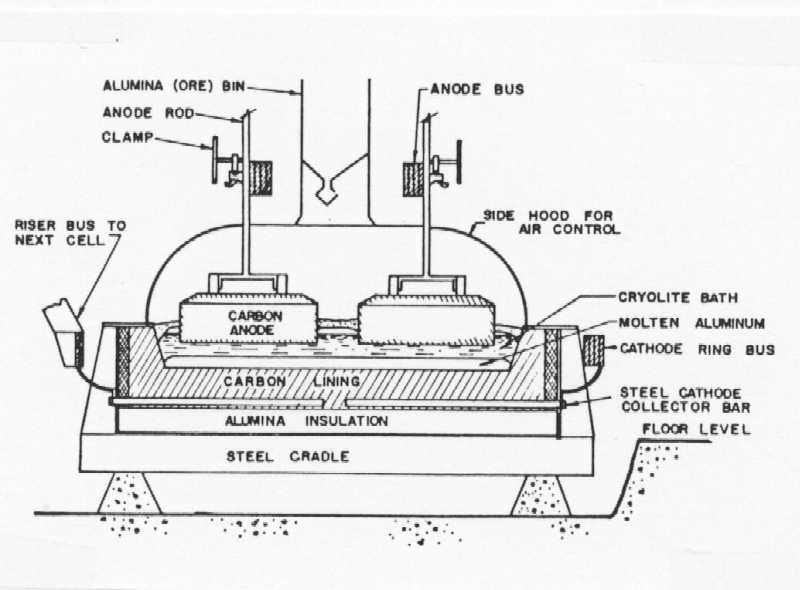
Every soda can, aircraft fuselage, and electric-vehicle frame begins inside a Hall–Héroult reduction cell: a massive rectangular bath, often 15 m long and 4 m wide, operating at ~960 °C. Inside, alumina ($\text{Al}_2\text{O}_3$) dissolved in molten cryolite salt ($\text{Na}_3\text{AlF}_6$) is electrolyzed into pure liquid aluminium, which pools at the bottom of the cell beneath the cryolite layer.
To produce aluminium economically, a single modern “pot” draws $300\text{--}600\;\text{kA}$ of direct current—making primary aluminium smelting responsible for roughly 2–3% of global electricity consumption. Nearly half of that electrical energy is wasted simply pushing current through the resistive molten cryolite gap ($h_{\text{bath}} \approx 4\text{--}5\;\text{cm}$) between the suspended carbon anodes and the liquid aluminium pad below.
So why don’t smelters simply shrink that gap to $1\text{--}2\;\text{cm}$ to save gigawatts of power? Because of magnetohydrodynamics. The huge busbars carrying $500\;\text{kA}$ create stray magnetic fields permeating the cell. If the cryolite gap becomes too thin, those magnetic fields interact with the electrolysis current to whip the liquid aluminium into a violent, rotating sloshing wave—the metal-pad roll instability—which touches the anodes, short-circuits the cell, and destroys efficiency.
How a Slight Tilt Turns Into a Rotating MHD Wave
The beauty—and danger—of the metal-pad roll lies in a massive conductivity contrast:
- Molten cryolite bath: $\sigma_{\text{bath}} \approx 220\;\text{S/m}$ (poor conductor, $\rho_1 \approx 2100\;\text{kg/m}^3$)
- Liquid aluminium pad: $\sigma_{\text{Al}} \approx 3.8\times 10^6\;\text{S/m}$ (17,000× more conductive, $\rho_2 \approx 2300\;\text{kg/m}^3$)
When the interface tilts upward on one side of the cell, the local cryolite thickness shrinks there, lowering electrical resistance and drawing extra vertical current through the crest. That excess current must flow horizontally ($\mathbf{J}_h$) through the low-resistance aluminium pad to reach the cathode collector bars. When $\mathbf{J}_h$ crosses the vertical stray magnetic field $B_z$ from the potline busbars, the Lorentz force $\mathbf{J}_h \times B_z \hat{\mathbf{z}}$ pushes the metal sideways—perpendicular to the initial tilt—exciting a second standing wave mode out of phase with the first, and feeding energy continuously into a rotating slosh.
Professional Deep Dive: Sele–Davidson Criterion & Mode Coupling
1. Shallow-Water Interfacial Wave Equations
Because the bath depth $h_1$ and metal depth $h_2$ are much smaller than the cell horizontal dimensions ($L_x, L_y$), the interface elevation $\zeta(x,y,t)$ is modeled by coupled two-layer shallow-water MHD equations (Davidson & Lindsay, 1998). Taking the depth-averaged horizontal momentum difference and applying the electrostatic jump condition across the resistive bath gives the perturbed wave equation:
$$\frac{\partial^2 \zeta}{\partial t^2} - c_0^2 \nabla_h^2 \zeta = \frac{1}{\rho_2 h_2 + \rho_1 h_1} \nabla_h \cdot \big( \mathbf{f}_{\text{Lorentz}} \big)$$where $c_0 = \sqrt{\frac{(\rho_2 - \rho_1) g}{\rho_1 / h_1 + \rho_2 / h_2}}$ is the unperturbed interfacial gravity-wave speed (typically $c_0 \approx 0.15\text{--}0.25\;\text{m/s}$ since $\Delta \rho / \rho \approx 0.09$).
2. Mode Coupling & the Sele Instability Parameter
Expanding $\zeta(x,y,t)$ in the rectangular tank’s natural gravity-wave eigenmodes $\zeta_{mn} \propto \cos(m\pi x/L_x)\cos(n\pi y/L_y)$ with natural frequencies $\omega_{mn} = c_0 \pi \sqrt{(m/L_x)^2 + (n/L_y)^2}$ reveals why coupling between two modes (e.g., $(1,0)$ and $(0,1)$) drives instability:
- The Lorentz operator $\mathcal{L}_{\text{MHD}}$ induced by $\mathbf{J}_h \times B_z \hat{\mathbf{z}}$ is skew-symmetric (non-self-adjoint).
- For two modes with frequencies $\omega_1, \omega_2$, the coupled eigenvalue equation yields complex-conjugate growth rates whenever the magnetic coupling parameter $\beta$ exceeds the frequency detuning $|\omega_1^2 - \omega_2^2|$:
This dimensionless ratio is Sele’s criterion (1977), placed on a rigorous variational and asymptotic footing by Davidson & Lindsay (1998) and Lukyanov et al. (2001).
3. Industrial Mitigation Strategies
Modern $500\text{--}600\;\text{kA}$ smelters control metal-pad roll using three MHD design principles:
- Busbar Magnetic Compensation: Routing potline busbars symmetrically beneath and alongside the cell minimizes $B_z$ ($< 1\text{--}2\;\text{mT}$) and cancels odd-symmetry stray fields.
- Aspect-Ratio Detuning: Choosing $L_x / L_y$ so that $\omega_{10}$ and $\omega_{01}$ are well separated widens the stability margin $\beta_{\text{crit}}$.
- Structured/Drained Cathodes: Wettable $\text{TiB}_2$ cathodes or grooved collector designs reduce $h_2$ or break up long-wavelength horizontal return currents $\mathbf{J}_h$, enabling anode–cathode distance (ACD) reduction and substantial $\text{kWh/kg Al}$ savings.
Key Milestones & Literature Review
- Empirical Stability & Long-Wave Formulation (1977–1994): Building on Torleif Sele’s empirical pot-stability parameter $\beta$, Valdis Bojarevics and Michel V. Romerio (1994) formulated the coupled two-layer shallow-water MHD equations for long interfacial waves and benchmarked them against industrial potline instabilities.
- Variational & Mode-Coupling Theory (1998): P. A. Davidson and R. I. Lindsay (1998) proved why metal-pad roll is fundamentally a skew-symmetric mode-coupling instability between orthogonal standing gravity waves—such as $(1,0)$ and $(0,1)$—explaining why square cells are the most unstable and aspect-ratio detuning stabilizes smelters.
- Asymptotic Wave Dispersion & General Geometries (2001–2017): A. Lukyanov, G. El, and S. Molokov (2001) extended interfacial MHD dispersion relations to arbitrary magnetic-field profiles and channel shapes, while P. A. Davidson (2017) synthesized potline busbar compensation and stability limits.
References
- Davidson, P. A., & Lindsay, R. I. (1998). Stability of interfacial waves in aluminium reduction cells. Journal of Fluid Mechanics, 362, 273–295. https://doi.org/10.1017/S0022112098001025
- Bojarevics, V., & Romerio, M. V. (1994). Long waves instability of liquid metal-electrolyte interface in aluminium electrolysis cells: A comparison with Sele's criterion. European Journal of Mechanics - B/Fluids, 13(1), 33–56.
- Lukyanov, A., El, G., & Molokov, S. (2001). Instability of MHD-modified interfacial waves: applications to aluminium reduction cells. Physics Letters A, 290(3–4), 165–172. https://doi.org/10.1016/S0375-9601(01)00643-0
- Davidson, P. A. (2017). Introduction to Magnetohydrodynamics (2nd ed.). Cambridge University Press. https://doi.org/10.1017/9781316672853