
Electric Arcs, VAR & Electroslag Remelting (ESR)
How 10–40 kA melting currents self-stir molten superalloy pools via electro-vortex flow—and why external Helmholtz magnetic coils prevent freckle defects in aerospace ingots.
Forging Jet-Engine Superalloys with Controlled Lightning
Every jet-engine turbine disk, rocket-nozzle casing, and surgical titanium implant must be virtually free of microscopic voids or chemical segregation. To achieve that purity, metallurgists take an already-cast alloy cylinder and melt it a second time, drop by drop, inside a water-cooled copper crucible using one of two extreme MHD processes:
- Vacuum Arc Remelting (VAR): A $10\text{--}30\;\text{kA}$ DC electric arc strikes in vacuum between the consumable alloy electrode above and a growing molten pool below.
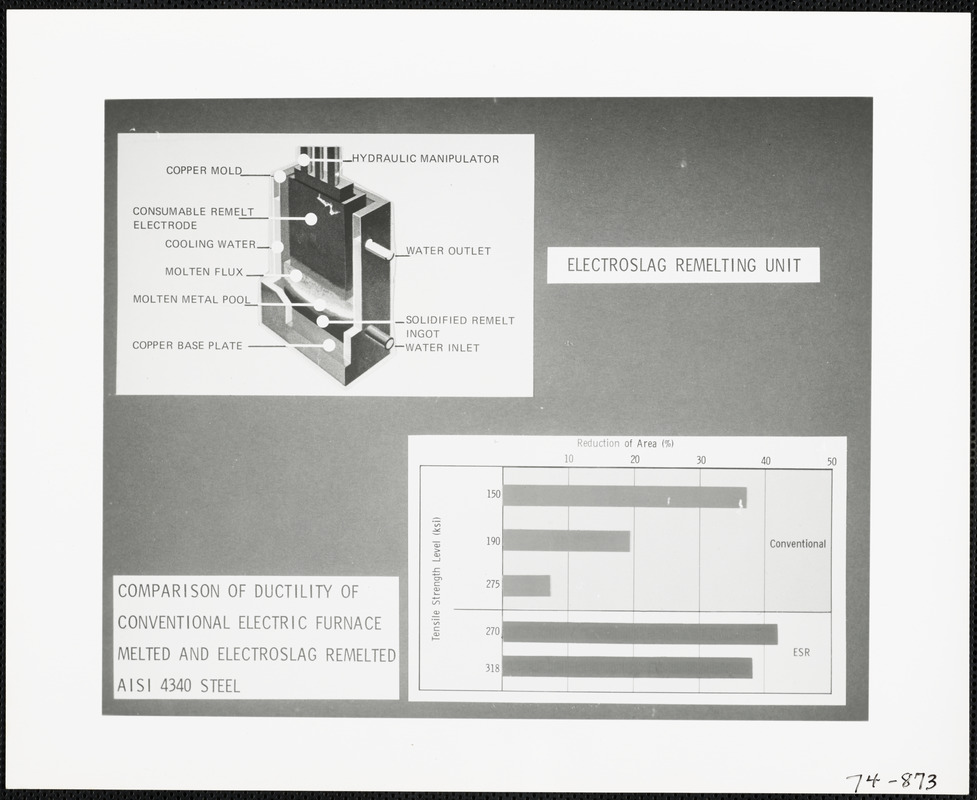
- Electroslag Remelting (ESR): Instead of a vacuum arc, the electrode dips into a superheated molten fluoride/oxide slag ($\text{CaF}_2\text{--Al}_2\text{O}_3\text{--CaO}$). Passing $15\text{--}40\;\text{kA}$ through the resistive slag generates intense Joule heating that melts droplets off the electrode, chemically scrubbing sulfur and oxide inclusions as they sink through the slag into the liquid metal pool below.
In both processes, the melting current does double duty: it supplies the heat and acts as an internal MHD stirrer. Whether that stirring helps or ruins the ingot depends on controlling electro-vortex flow and external magnetic stirring.
Professional Deep Dive: Electro-Vortex Flow, Buoyancy Competition & Freckle Prevention
1. Self-Induced Electro-Vortex Flow (EVF)
Because the consumable electrode radius $R_e$ is smaller than the crucible radius $R_m$ ($R_e / R_m \approx 0.6\text{--}0.85$), the electric current $\mathbf{J}$ diverges radially outward as it crosses from the electrode/slag into the molten metal pool. The interaction of $\mathbf{J}$ with its own azimuthal magnetic field $B_\theta(r,z)$ yields a rotational Lorentz force ($\nabla \times (\mathbf{J} \times \mathbf{B}) \neq 0$):
$$(\nabla \times \mathbf{F}_L)_\theta = -\frac{\partial}{\partial z} \left( \frac{B_\theta^2}{\mu_0 r} \right) \neq 0$$Because $B_\theta$ is stronger near the narrower top of the pool than near the wider bottom, magnetic pinch pressure is higher at the top axis, driving a downward central jet along the centerline ($r = 0$) and upward return flow along the solidifying mushy-zone wall (Bojarevics et al., 1989; Kharicha et al., 2017). The intensity is measured by the electro-vortex parameter:
$$S = \frac{\mu_0 I^2}{4\pi^2 \rho \nu^2}$$At typical ESR/VAR currents ($I \sim 20\;\text{kA}$), $S \sim 10^9\text{--}10^{11}$, driving turbulent jets of $0.1\text{--}0.5\;\text{m/s}$.
2. Thermal Buoyancy vs. Lorentz Pinch: Pool Shape & “Freckles”
Inside the molten pool, EVF competes directly with thermal buoyancy:
- Thermal natural convection pulls cooler liquid downward along the water-cooled mould wall and pushes hotter liquid upward at the center—opposite to EVF.
- If EVF dominates, the downward central jet carries superheated metal deep into the center, carving a deep V-shaped pool that promotes centerline segregation.
- If buoyancy and weak stirring leave stagnant pockets in the dendritic mushy zone, interdendritic liquid enriched in light elements (e.g., $\text{Al}$, $\text{Ti}$) rises in thermosolutal plumes, leaving vertical defect channels called freckles that scrap aerospace ingots.
3. External Axial Magnetic Field ($B_z$) in VAR
To stabilize the vacuum arc and tailor pool convection, VAR furnaces wrap external Helmholtz coils around the copper crucible to apply a weak axial field $B_z \sim 1\text{–}10\text{ mT}$ (Davidson et al., 2000). Crossing $B_z$ with the diverging radial current $J_r$ creates an azimuthal Lorentz torque $F_\theta = -J_r B_z$ that spins the melt. Reversing $B_z$ periodically (alternating stirring) breaks up steady azimuthal shear layers, flattens the solidification front, and suppresses freckle formation.
Key Milestones & Literature Review
- VAR Arc & Pool Observations (1982): F. J. Zanner and L. A. Bertram (1982) pioneered high-speed vacuum-arc diagnostics and coupled thermal–MHD pool modeling at Sandia National Laboratories, linking arc constriction and drip-shorting to ingot solidification defects.
- Theory of Electrically Induced Vortical Flows (1989): Valdis Bojarevics, Y. Freibergs, E. I. Shilova, and E. V. Shcherbinin (1989) established the analytical and numerical foundation of electro-vortex flows (EVF) driven by diverging current in axisymmetric crucibles.
- External Magnetic Stirring & Flow Transitions (2000): P. A. Davidson, X. He, and A. J. Lowe (2000) analyzed the competition between EVF, buoyancy, and $B_z$-driven swirl in VAR pools, showing how alternating axial fields suppress steady shear layers and freckles.
- Multiphase 3D ESR/VAR Modeling (2017): Abdellah Kharicha, Menghuai Wu, and Andreas Ludwig (2017) developed coupled 3D multiphase MHD models resolving droplet detachment, slag–metal interfacial waves, and arc-plasma coupling.
References
- Kharicha, A., Wu, M., & Ludwig, A. (2017). Advances in the Magnetohydrodynamic Modeling of Electroslag Remelting and Vacuum Arc Remelting. Steel Research International, 88(12), 1700100. https://doi.org/10.1002/srin.201700100
- Davidson, P. A., He, X., & Lowe, A. J. (2000). Flow transitions in vacuum arc remelting. Materials Science and Technology, 16(6), 699–711. https://doi.org/10.1179/026708300101508306
- Bojarevics, V., Freibergs, Y., Shilova, E. I., & Shcherbinin, E. V. (1989). Electrically Induced Vortical Flows. Kluwer Academic Publishers.
- Zanner, F. J., & Bertram, L. A. (1982). Vacuum arc remelting: An overview. Sandia National Laboratories / Metallurgical Transactions B.