
Astrophysical MHD: Accretion Disks, Jets & the Solar Corona
Why gravity alone cannot make gas fall into black holes or launch relativistic jets—and how the Magnetorotational Instability (MRI), Blandford-Znajek mechanism, and Parker reconnection rule the cosmos.
Why Black Holes Shine and Stars Explode
Over 99% of visible matter in the universe is plasma—hot ionized gas threaded by magnetic fields. On cosmic scales, magnetic Reynolds numbers are astronomical ($Rm \sim 10^{12}\text{--}10^{20}$), meaning magnetic field lines are virtually “frozen” into the plasma and stretched into cosmic slingshots, dynamos, and particle accelerators.
Without magnetohydrodynamics, two of the universe’s brightest phenomena would be impossible:
- Why matter falls into black holes and young stars: Gas orbiting a black hole in an accretion disk has too much angular momentum to fall straight in—just as Earth does not fall into the Sun. Ordinary molecular viscosity is billions of times too weak to drain that angular momentum. Magnetic fields act as invisible elastic bands linking inner, faster-orbiting gas to outer, slower-orbiting gas, triggering magnetorotational turbulence that lets matter spiral inward and heat up to X-ray temperatures.
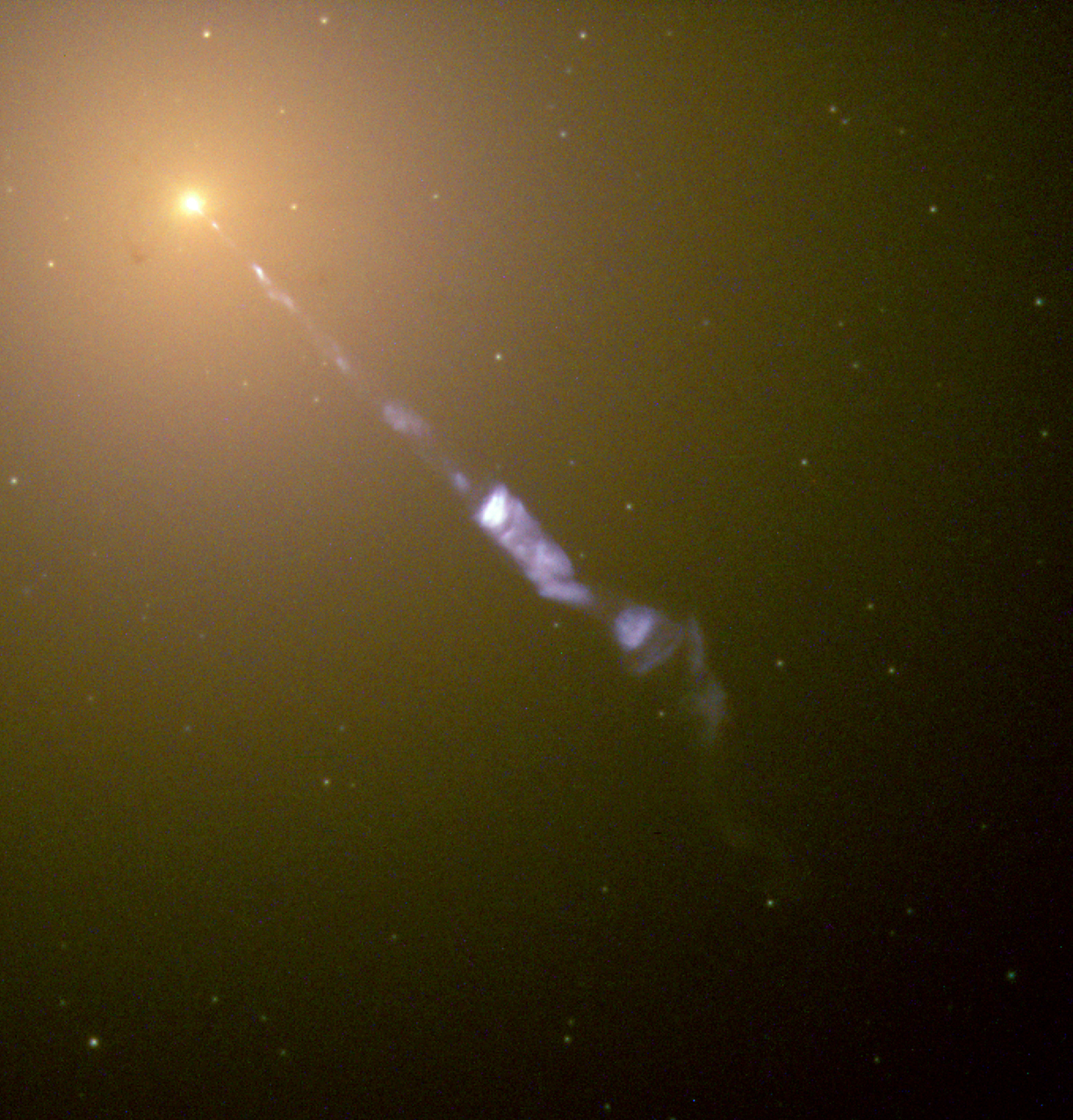
- How galaxies launch light-year-long plasma jets: Even as black holes swallow matter, twisted magnetic fields anchored in the spinning disk or the black hole’s own spacetime ergosphere fling a fraction of the plasma outward at nearly the speed of light, sculpting collimated relativistic jets spanning tens of thousands of light-years.
Professional Deep Dive: MRI, Jet Launching & Solar Reconnection
1. The Magnetorotational Instability (MRI)
A Keplerian accretion disk has specific angular momentum $\ell = r^2 \Omega(r) \propto r^{1/2}$ increasing outward ($\frac{d\ell^2}{dr} > 0$), which makes it hydrodynamically stable by Rayleigh’s criterion. However, threading the disk with even a weak vertical magnetic field $B_z$ destabilizes it via the Magnetorotational Instability (MRI) (Balbus & Hawley, 1998).
Because magnetic tension links fluid elements at slightly different radii like a spring with spring constant $\propto (\mathbf{k}\cdot\mathbf{v}_A)^2$ (where $v_A = B/\sqrt{\mu_0 \rho}$ is the Alfvén speed), an inner fluid parcel loses angular momentum to an outer parcel and falls further inward while the outer parcel moves further outward. Linear dispersion analysis yields instability whenever:
$$(\mathbf{k}\cdot\mathbf{v}_A)^2 < -\frac{d\Omega^2}{d\ln r} = 3\Omega^2 \quad \text{(Keplerian disk)}$$with a maximum growth rate $\gamma_{\max} = \frac{3}{4}\Omega$—growing by a factor of $e^{3\pi/2} \approx 111$ in a single orbit! Nonlinear MRI sustains 3D MHD turbulence that delivers the effective Shakura–Sunyaev viscosity $\alpha_{\text{eff}} \sim 10^{-2}\text{--}10^{-1}$ needed to power quasars, X-ray binaries, and protoplanetary disks.
2. Magnetocentrifugal & Blandford–Znajek Jets
Two complementary MHD engines launch astrophysical jets:
- Blandford–Payne Mechanism (1982): Open poloidal field lines threading a Keplerian disk at an angle $> 30^\circ$ from the rotation axis act like rigid rotating wires; centrifugal force flings ionized gas outward along the field lines (“bead-on-a-wire”), while toroidal winding ($B_\phi$) creates a magnetic hoop stress $\frac{B_\phi^2}{\mu_0 r}$ that collimates the outflow into a narrow jet.
- Blandford–Znajek Mechanism (1977): For spinning Kerr black holes, frame-dragging twists magnetic flux threading the event horizon, electromagnetically extracting rotational energy at power $P_{\text{BZ}} \propto \Phi_{\text{BH}}^2 \Omega_H^2 / c$.
3. Solar Corona Heating & Magnetic Reconnection
In the Sun’s corona, plasma $\beta = \frac{2\mu_0 p}{B^2} \ll 1$, so magnetic pressure and tension dominate fluid dynamics. Convective footpoint shuffling braids coronal loops until thin current sheets form, where finite resistivity or Hall/kinetic effects break the frozen-in condition via magnetic reconnection (Parker, 1957; tearing/plasmoid instabilities at Lundquist number $S \sim 10^{12}$). Reconnection rapidly converts stored magnetic energy $\frac{B^2}{2\mu_0}$ into bulk Alfvénic jets, particle acceleration, and $10^7\text{ K}$ solar flares and coronal mass ejections (CMEs).
Key Milestones & Literature Review
- Magnetic Reconnection Theory (1957): Eugene N. Parker (1957) formulated the Sweet–Parker current-sheet reconnection model, showing how opposing magnetic fields merge and convert magnetic energy into plasma kinetic and thermal energy in solar flares.
- Black-Hole & Disk Jet Engines (1977–1982): Roger D. Blandford and Roman L. Znajek (1977) proved that frame-dragging around a spinning Kerr black hole electromagnetically extracts rotational energy along horizon-threading flux, while Roger D. Blandford and D. G. Payne (1982) demonstrated magnetocentrifugal launching and hoop-stress collimation of jets from magnetized accretion disks.
- Magnetorotational Instability (1998): Steven A. Balbus and John F. Hawley (1998) solved the long-standing accretion-disk angular-momentum puzzle by showing that even weak magnetic fields destabilize Keplerian shear via the MRI, driving 3D MHD turbulence across quasars and protoplanetary disks.
References
- Balbus, S. A., & Hawley, J. F. (1998). Instability, turbulence, and enhanced transport in accretion disks. Reviews of Modern Physics, 70(1), 1–53. https://doi.org/10.1103/RevModPhys.70.1
- Blandford, R. D., & Payne, D. G. (1982). Hydromagnetic flows from accretion discs and the production of radio jets. Monthly Notices of the Royal Astronomical Society, 199(4), 883–903. https://doi.org/10.1093/mnras/199.4.883
- Blandford, R. D., & Znajek, R. L. (1977). Electromagnetic extraction of energy from Kerr black holes. Monthly Notices of the Royal Astronomical Society, 179(3), 433–456. https://doi.org/10.1093/mnras/179.3.433
- Parker, E. N. (1957). Sweet's mechanism for merging magnetic fields in conducting fluids. Journal of Geophysical Research, 62(4), 509–520. https://doi.org/10.1029/JZ062i004p00509