
Electromagnetic Processing of Materials (EPM)
How steelmakers and foundries use contactless magnetic fields to stir, brake, levitate, and shape molten metals during continuous casting and induction melting.
Touching 1600 °C Molten Metal Without Touching It
Inside a modern steel mill or titanium foundry, molten metal glows at 1500–1800 °C. Mechanical paddles would melt or contaminate the alloy in seconds. Electromagnetic Processing of Materials (EPM) solves this by using invisible magnetic fields to stir, brake, heat, levitate, and shape liquid metals entirely without physical contact. Today, nearly every high-grade automotive steel slab, aerospace superalloy billet, and solar-grade silicon ingot relies on MHD forces during solidification.
Depending on whether the magnetic field is steady (DC) or alternating/travelling (AC), engineers get opposite—and complementary—tools:
- AC fields induce eddy currents inside the melt. Their interaction with the magnetic field creates a vigorous Lorentz force that stirs the melt (homogenizing temperature and alloy composition) or pinches it away from the mould wall (reducing surface defects).
- Static DC fields act like an invisible viscous brake. Whenever turbulent liquid metal tries to cross steady magnetic field lines, induced currents generate an opposing Lorentz force that damps excessive jets and surface waves.
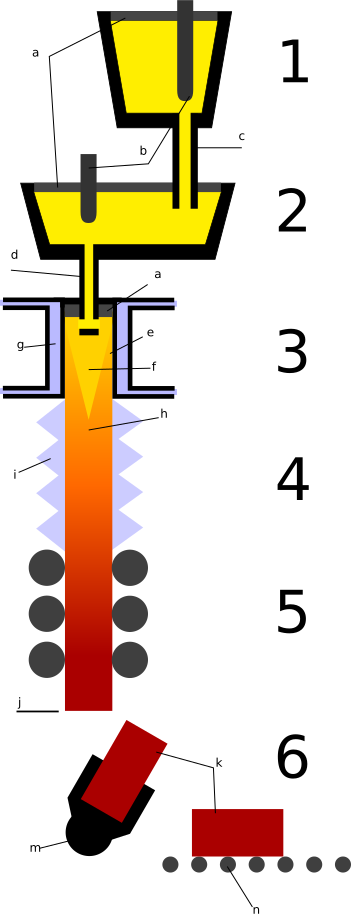
Core Industrial EPM Technologies
- Electromagnetic Stirring (EMS): Travelling three-phase AC coils wrapped around the mould or secondary cooling zone spin the liquid core. Controlled rotation washes away superheated dendrites, breaks up columnar grain growth, and shifts the solidification microstructure toward fine equiaxed grains, eliminating centerline segregation and porosity (Takeuchi et al., 2010).
- Electromagnetic Braking (EMBr): In high-speed slab casting ($> 2\;\text{m/min}$), twin jets shooting out of the submerged entry nozzle (SEN) can tear mould flux slag into the solidifying shell, causing sliver defects. A transverse DC dipole field ($0.2\text{--}0.5\;\text{T}$) across the mould width damps jet momentum and flattens the free surface meniscus.
- Electromagnetic Casting (EMC) & Cold Crucible Levitation: High-frequency AC coils induce intense skin currents in a melt charge, creating a magnetic pressure $B^2/(2\mu_0)$ that supports the liquid column away from a segmented water-cooled copper crucible—allowing ultra-pure melting of reactive titanium or silicon with zero ceramic contamination (Bojarevics & Pericleous, 2015).
Professional Deep Dive: Skin Depth, Magnetic Pressure & Hartmann Damping
1. AC Induction Stirring & Pinching
For a time-harmonic magnetic field of angular frequency $\omega = 2\pi f$ applied to a liquid metal of conductivity $\sigma$ and permeability $\mu_0$, the electromagnetic field penetrates only to the skin depth:
$$\delta = \sqrt{\frac{2}{\mu_0 \sigma \omega}}$$- Low-frequency stirring (EMS, $f \sim 1\text{--}10\;\text{Hz}$): $\delta$ is comparable to the strand radius ($0.1\text{--}0.3\;\text{m}$), so the rotational part of the Lorentz force $\nabla \times \mathbf{F}_L$ penetrates deeply and drives bulk azimuthal or meridional circulation.
- High-frequency confinement (EMC / Cold Crucible, $f \sim 10^3\text{--}10^5\;\text{Hz}$): $\delta \ll R$. Decomposing $\mathbf{F}_L = \mathbf{J} \times \mathbf{B}$ via Ampère’s law yields: $$\mathbf{J} \times \mathbf{B} = \frac{1}{\mu_0}(\mathbf{B}\cdot\nabla)\mathbf{B} - \nabla \left(\frac{B^2}{2\mu_0}\right)$$ The gradient term acts as an isotropic magnetic pressure $p_m = \frac{B_{\text{rms}}^2}{2\mu_0}$ that balances hydrostatic pressure $\rho g h$ at the free meniscus, while the curl of the time-averaged Lorentz force drives intense internal recirculation in the thin skin layer.
2. DC Electromagnetic Braking (EMBr)
In a static field $\mathbf{B}_0$, fluid motion $\mathbf{u}$ induces $\mathbf{J} = \sigma(-\nabla \phi + \mathbf{u} \times \mathbf{B}_0)$. Because the magnetic Reynolds number in metallurgical melts is small ($Rm = \mu_0 \sigma u L \sim 10^{-2}\text{--}10^{-1}$), the induced magnetic field is negligible (the quasi-static MHD approximation). The governing dimensionless groups are:
- Hartmann number: $Ha = B_0 L \sqrt{\frac{\sigma}{\rho \nu}}$ (typically $Ha \sim 10^2\text{--}10^3$ in steel EMBr), measuring electromagnetic-to-viscous forces.
- Interaction parameter (Stuart number): $N = \frac{\sigma B_0^2 L}{\rho u} = \frac{Ha^2}{Re}$, measuring electromagnetic braking relative to fluid inertia.
In a DC brake, the Lorentz force acts anisotropically: eddies whose axes are perpendicular to $\mathbf{B}_0$ induce currents that close through walls or stagnant fluid, dissipating kinetic energy as Joule heat on the magnetic damping timescale $\tau_J \sim \rho / (\sigma B_0^2)$ while elongating vortices along the field lines into quasi-2D structures.
Key Milestones & Literature Review
- Foundations of EPM (2000): Shigeo Asai (2000) defined the unifying discipline of Electromagnetic Processing of Materials, cataloging how static DC fields, travelling AC stirrers, high-frequency cold crucibles, and electromagnetic vibrations control solidification microstructures and inclusion trajectories.
- Industrial Steelmaking Deployment (2010): Eiichi Takeuchi, Masafumi Zeze, and Hiroyuki Tanaka (2010) reviewed decades of Japanese steelmaking R&D, demonstrating how single- and double-ruler DC electromagnetic brakes (EMBr) and in-mould electromagnetic stirrers (M-EMS) suppress meniscus wave-breaking and centerline segregation in high-speed continuous slab casting.
- Cold-Crucible & Levitation Modeling (2015–2017): Valdis Bojarevics and Koulis Pericleous (2015) developed coupled 3D spectral-MHD and free-surface solvers for cold-crucible induction melting and levitation of reactive titanium alloys, while P. A. Davidson (2017) formalized anisotropic Hartmann damping in metallurgical flows.
References
- Takeuchi, E., Zeze, M., & Tanaka, H. (2010). Review of Electromagnetic Processing of Materials in Steelmaking. ISIJ International, 50(8), 1134–1144. https://doi.org/10.2355/isijinternational.50.1134
- Asai, S. (2000). Recent development and prospect of electromagnetic processing of materials. Science and Technology of Advanced Materials, 1(4), 191–200. https://doi.org/10.1016/S1468-6996(00)00019-X
- Davidson, P. A. (2017). Introduction to Magnetohydrodynamics (2nd ed.). Cambridge University Press. https://doi.org/10.1017/9781316672853
- Bojarevics, V., & Pericleous, K. (2015). Electromagnetic levitation and induction melting: MHD modeling and industrial applications. Magnetohydrodynamics, 51(1), 119–130. https://doi.org/10.22364/mhd.51.1.12