
Ferrofluids & Ferrohydrodynamics
Why spiky liquid magnets need no electric current to move—exploring Rosensweig normal-field instability, Kelvin polarization forces, rotational viscosity, and rotary shaft seals.
A Liquid That Sprouts Spikes in a Magnetic Field
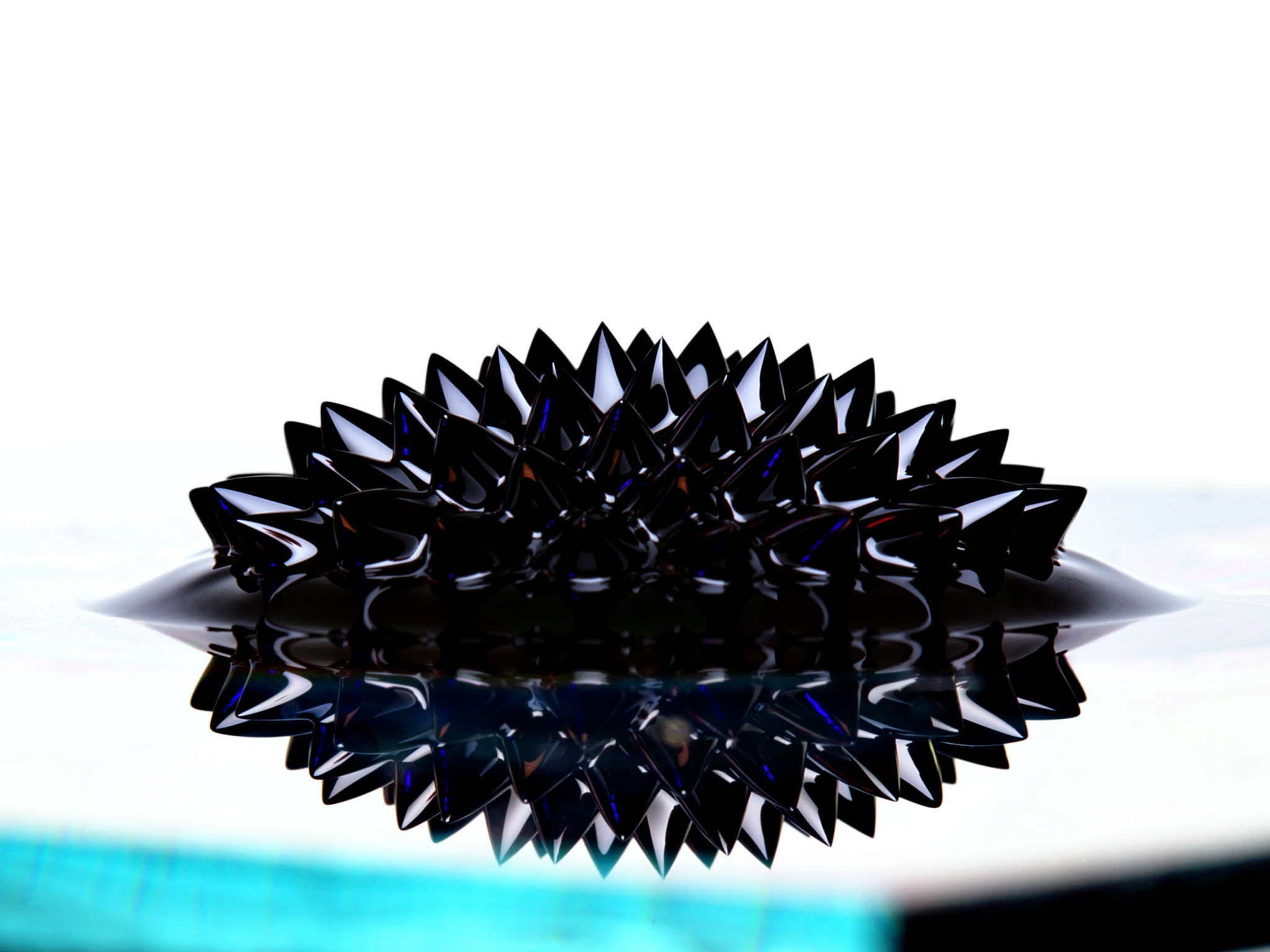
Bring a neodymium magnet beneath a dish of black ferrofluid, and the flat liquid surface suddenly erupts into a mesmerizing geometric forest of sharp, shimmering peaks. Originally invented by NASA engineer Steve Papell in 1963 to pump rocket fuel in zero gravity, ferrofluids are today found inside millions of loudspeaker voice coils (conducting heat away), computer hard-drive rotary seals, and targeted medical imaging and hyperthermia nanoparticles.
Crucially, ferrohydrodynamics (FHD) is physically distinct from classical MHD:
- In MHD (liquid metals, plasmas), fluid moves because free electric currents cross a magnetic field ($\mathbf{J} \times \mathbf{B}$).
- In ferrofluids, the carrier liquid (oil or water) is an electrical insulator ($\mathbf{J} = 0$). Instead, it holds trillions of $10\;\text{nm}$ magnetite ($\text{Fe}_3\text{O}_4$) nanoparticles coated in surfactant so they never clump. Each nanoparticle is a single-domain permanent magnet suspended in thermal Brownian motion, giving the bulk liquid superparamagnetic magnetization $\mathbf{M}$ that responds directly to magnetic field gradients ($\nabla H$).
Professional Deep Dive: Kelvin Force, Rosensweig Instability & Rotational Viscosity
1. The Ferrohydrodynamic Momentum Equation
For a non-conducting, incompressible ferrofluid with magnetization $\mathbf{M}$ parallel to the local magnetic field $\mathbf{H}$ ($\mathbf{B} = \mu_0(\mathbf{H} + \mathbf{M})$), the magnetic body force is the Kelvin polarization force $\mu_0 (\mathbf{M} \cdot \nabla)\mathbf{H}$ (Rosensweig, 1985):
$$\rho \left( \frac{\partial \mathbf{u}}{\partial t} + (\mathbf{u}\cdot\nabla)\mathbf{u} \right) = -\nabla p^* + \eta \nabla^2 \mathbf{u} + \mu_0 M \nabla H + \rho \mathbf{g}$$where $p^*$ absorbs magnetostrictive pressure. Notice that in a uniform magnetic field ($\nabla H = 0$), the Kelvin force vanishes identically—meaning a ferrofluid feels a net pull only toward regions of stronger field gradient (which is why ferrofluid seals stay locked inside narrow magnet gaps against pressure differentials).
2. The Rosensweig Normal-Field Instability
When a uniform magnetic field $H_0$ is applied perpendicular to a flat ferrofluid interface, any small sinusoidal ripple $\zeta \propto e^{i(kx - \omega t)}$ concentrates magnetic flux lines at the crests, lowering magnetic energy and trying to pull crests higher, while gravity $\rho g$ and surface tension $\gamma$ restore flatness. Linear dispersion analysis (Cowley & Rosensweig, 1967) yields:
$$\omega^2 = \frac{1}{\rho} \left( \rho g k + \gamma k^3 - \frac{\mu_0 \chi^2 H_0^2}{2 + \chi} k^2 \right)$$Instability ($\omega^2 < 0$) first sets in at the critical capillary wavenumber $k_c = \sqrt{\rho g / \gamma}$ when the magnetization exceeds the Cowley–Rosensweig threshold:
$$M_c^2 = \frac{2}{\mu_0} \left(1 + \frac{1}{\chi_0}\right) \sqrt{\rho g \gamma}$$Beyond $M_c$, nonlinear saturation locks the surface into the iconic stationary hexagonal lattice of peaks.
3. Magnetoviscosity & Internal Angular Momentum
When a ferrofluid flows under shear ($\boldsymbol{\Omega} = \frac{1}{2}\nabla \times \mathbf{u}$) in an applied field $\mathbf{H}$, viscous torque tries to spin the nanoparticles while the magnetic torque $\mu_0 (\mathbf{m} \times \mathbf{H})$ tries to align their magnetic moments with $\mathbf{H}$. This misalignment creates an asymmetric stress tensor and an extra rotational viscosity $\Delta \eta_{\text{rot}}$ (Shliomis, 1972; Odenbach, 2002):
$$\Delta \eta_{\text{rot}} = \frac{3}{2} \phi \eta_0 \frac{\xi - \tanh\xi}{\xi + \tanh\xi} \sin^2\beta, \qquad \xi = \frac{\mu_0 m H}{k_B T}$$where $\phi$ is the particle volume fraction and $\beta$ is the angle between $\mathbf{H}$ and local vorticity $\boldsymbol{\Omega}$. Under an oscillating or rotating magnetic field, the spin-up of nanoparticles can even pump the carrier fluid via the spin-up / ferrofluid pumping effect without any moving mechanical rotor.
Key Milestones & Literature Review
- Normal-Field Instability & Ferrohydrodynamics (1967–1985): M. D. Cowley and Ronald E. Rosensweig (1967) discovered and derived the critical magnetization threshold $M_c$ for the iconic hexagonal spike instability; Rosensweig (1985) subsequently unified Kelvin force continuum mechanics, Bernoulli equations for magnetic liquids, and rotary-seal engineering in his landmark monograph.
- Rotational Viscosity & Micro-Hydrodynamics (1972): Mark I. Shliomis (1972) formulated the magnetization-relaxation equation and derived the magnetic-field-induced rotational viscosity $\Delta\eta_{\text{rot}}$ arising from hindered nanoparticle rotation in shear flow.
- Magnetoviscous Rheology & Applications (2002): Stefan Odenbach (2002) experimentally and theoretically quantified particle–particle dipolar chain formation, shear thinning, and magnetoviscous damping in concentrated ferrofluids.
References
- Rosensweig, R. E. (1985). Ferrohydrodynamics. Cambridge University Press (Dover reprint 1997).
- Cowley, M. D., & Rosensweig, R. E. (1967). The interfacial stability of a ferromagnetic fluid. Journal of Fluid Mechanics, 30(4), 671–688. https://doi.org/10.1017/S0022112067001697
- Odenbach, S. (2002). Magnetoviscous Effects in Ferrofluids. Springer. https://doi.org/10.1007/3-540-45646-5
- Shliomis, M. I. (1972). Effective viscosity of magnetic suspensions. Soviet Physics JETP, 34(6), 1291–1294.