Liquid-Metal Cooling in Fusion & Fast Fission Reactors
Why nuclear fusion needs liquid-metal breeding blankets and why magnetohydrodynamics (MHD) governs their cooling loops: D–T fusion physics, tokamak magnetic confinement, high-Ha Pb–17Li pressure drops, flow-channel inserts, and sodium fast reactors.
1. What Is Nuclear Fusion?
$$\mathrm{D} + \mathrm{T} \longrightarrow {}^4\mathrm{He}\,(3.5\text{ MeV}) + n\,(14.1\text{ MeV})$$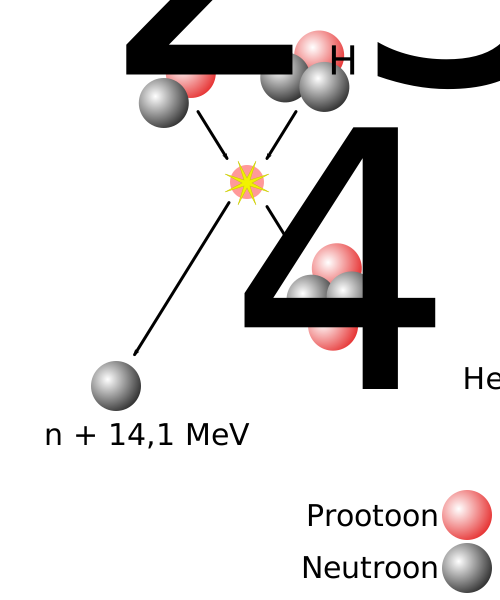
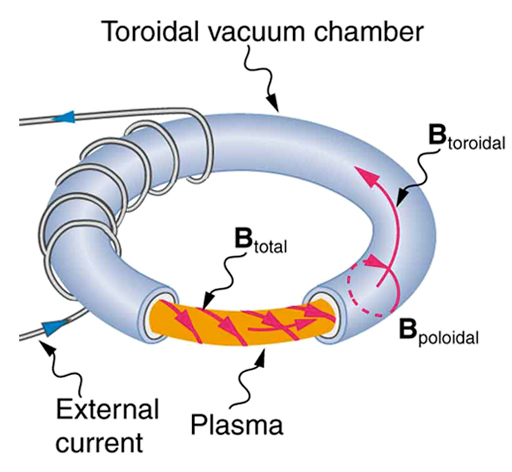
At $150\text{ million K}$, the D–T fuel is a fully ionized plasma that no solid wall can touch. Magnetic confinement devices such as tokamaks and stellarators trap this plasma inside a toroidal “magnetic bottle” using massive superconducting coils generating intense magnetic fields ($B_0 \sim 4\text{–}12\text{ T}$). Meanwhile, because tritium ($\mathrm{T}$, half-life 12.3 years) does not occur naturally in usable quantities, the reactor must surround the plasma with a lithium-bearing breeding blanket that captures the escaping $14.1\text{ MeV}$ neutrons to breed new tritium via ${}^6\mathrm{Li}(n,\alpha)\mathrm{T}$ while converting the neutron kinetic energy into heat for electricity generation.
2. Why Is MHD Relevant to Fusion Reactors?
While MHD governs the hot plasma core itself, liquid-metal MHD is equally decisive in the external breeding blanket and cooling loops surrounding the plasma:
- Why liquid metals? Eutectic lead–lithium ($\mathrm{Pb\text{–}17Li}$) and liquid lithium are top blanket fluids because they combine high thermal conductivity, high boiling points at low pressure, radiation immunity, and built-in lithium for tritium breeding.
- Why MHD kicks in: Liquid metals are excellent electrical conductors ($\sigma \sim 10^6\text{ S\,m}^{-1}$). Circulating them through the tokamak’s $4\text{–}8\text{ T}$ confining magnetic field induces strong electric currents ($\mathbf{J} = \sigma(\mathbf{E} + \mathbf{u} \times \mathbf{B}_0)$).
- Electromagnetic braking & flow restructuring: The resulting Lorentz force ($\mathbf{J} \times \mathbf{B}_0$) overwhelms fluid inertia and viscosity by orders of magnitude, reaching Hartmann numbers $\mathrm{Ha} \sim 10^3\text{–}10^4$ and interaction parameters $N \sim 10^3\text{–}10^5$ (at $\mathrm{Rm} \ll 1$, Müller & Bühler, 2001). This produces:
- Massive MHD pressure drops: When induced currents close through electrically conducting steel duct walls (wall-conductance ratio $c_w = \sigma_w t_w / (\sigma L)$), the pressure gradient scales as: $$-\frac{\mathrm{d}p}{\mathrm{d}x} \propto \sigma U B_0^2 \frac{c_w}{1 + c_w}$$ creating megapascal pressure drops that challenge structural stress limits and pumping power budgets.
- Turbulence suppression & Hunt jets: Turbulence is damped along $\mathbf{B}_0$, while bends, manifolds, and parallel channels develop electromagnetic flow coupling and sharp Hunt side-wall jets (Bühler et al., 2024) that alter heat transfer and tritium residence times.
3. Mitigation: Flow-Channel Inserts (FCIs) & Magneto-Convection
- Flow-Channel Inserts: In Dual-Coolant Lead–Lithium (DCLL) blankets, thin ceramic ($\mathrm{SiC}_f/\mathrm{SiC}$) sleeves line the steel ducts, electrically insulating the $\mathrm{PbLi}$ core from the structural walls and cutting MHD pressure drops by 1–2 orders of magnitude (Smolentsev et al., 2015).
- Buoyancy & Magneto-Convection: Intense volumetric neutron heating creates Grashof numbers $\mathrm{Gr} \sim 10^8\text{–}10^{12}$, driving mixed and natural magneto-convection—benchmarked experimentally in KIT’s MaPLE loop and international code comparisons (Mistrangelo et al., 2025).
4. Liquid-Metal Divertors & Sodium Fast Fission Reactors
- Liquid-Metal Divertors ($\mathrm{Li}, \mathrm{Sn}$): Self-healing liquid-metal plasma-facing targets (featured at ISLA-9) rely on MHD and thermoelectric ($\mathbf{J}_{\mathrm{TE}}\times\mathbf{B}$) forces to suppress droplet ejection under edge-localized modes (ELMs).
- Sodium-Cooled Fast Fission Reactors (SFRs): In Generation-IV fast fission reactors, hermetically sealed annular linear induction pumps (ALIP) and electromagnetic flowmeters circulate primary and secondary liquid sodium at ~500 °C with zero rotating shaft seals.
5. Key Milestones & MHD Literature Review
- Duct-Flow Theory & Asymptotic Foundations (1965–2001): Building on Hunt’s side-layer solutions and Walker’s asymptotic duct analysis, Ulrich Müller and Leo Bühler (2001) compiled the definitive monograph on high-Hartmann-number MHD flows in channels and containers, establishing analytical and numerical benchmarks for conducting and insulated breeding-blanket ducts.
- Verification & Validation of Fusion MHD Codes (2015): Sergey Smolentsev et al. (2015) introduced a structured verification and validation (V&V) framework for fusion blanket MHD solvers, addressing extreme parameter regimes ($Ha \sim 10^4$, $Gr \sim 10^{12}$) and flow-channel insert (FCI) electrical coupling.
- Complex Blanket Geometries & Code Benchmarks (2024–2025): Leo Bühler et al. (2024) synthesized experimental and numerical breakthroughs from KIT’s MEKKA facility on manifolds, U-bends, and Pb–17Li magneto-convection, while Chiara Mistrangelo, Leo Bühler, Sergey Smolentsev et al. (2025) completed an international code-to-code benchmark for buoyancy-driven magneto-convection in horizontal ducts.
References
- Müller, U. & Bühler, L. (2001). Magnetofluiddynamics in Channels and Containers. Springer-Verlag. doi:10.1007/978-3-662-04405-6
- Bühler, L. et al. (2024). Liquid metal MHD research at KIT: Fundamental phenomena and flows in complex blanket geometries. Fusion Engineering and Design 200, 114195. doi:10.1016/j.fusengdes.2024.114195
- Smolentsev, S. et al. (2015). An approach to verification and validation of MHD codes for fusion applications. Fusion Engineering and Design 100, 65–72. doi:10.1016/j.fusengdes.2014.04.049
- Mistrangelo, C., Bühler, L., Smolentsev, S., et al. (2025). A code-to-code benchmark for magneto-convection in a horizontal duct. Nuclear Fusion 65(11), 116006. doi:10.1088/1741-4326/ada6da