Magnetoelectrochemistry & Electrodeposition
How magnetic fields stir aqueous electrolytes, sweep away hydrogen bubbles in water electrolyzers, and sculpt nanostructured metal coatings via macro- and micro-MHD convection.
Stirring Water and Plating Metals With Invisible Forces
When we think of magnetohydrodynamics, we usually picture 1500 °C liquid steel or million-degree astrophysical plasma. Yet MHD also works quietly at room temperature inside beakers of saltwater, copper-plating baths, and green-hydrogen water electrolyzers.
Aqueous electrolytes have tiny electrical conductivity ($\sigma \sim 1\text{--}50\;\text{S/m}$)—roughly 100,000 times lower than liquid metals. At first glance, one might assume magnetic fields have no effect on them. In fact, because ions diffuse slowly through water, electrochemical reactions are almost always bottlenecked by a razor-thin stagnant fluid layer right at the electrode surface (the Nernst diffusion layer). Even a modest permanent magnet ($0.3\text{--}1\;\text{T}$) exerts enough Lorentz force ($\mathbf{J} \times \mathbf{B}$) on the ionic current to stir that boundary layer, boost reaction rates by $2\text{--}5\times$, and detach insulating gas bubbles ($\text{H}_2$, $\text{O}_2$) during electrolysis.
Professional Deep Dive: Macro-MHD, Micro-MHD & Magnetic Gradient Forces
1. Mass-Transport Enhancement & Limiting Current Scaling
In diffusion-limited electrodeposition (e.g., $\text{Cu}^{2+} + 2e^- \to \text{Cu}$), the Schmidt number is large ($Sc = \nu / D \approx 10^3$), so even weak fluid velocity dramatically thins the Nernst diffusion layer $\delta_N$. Applying a magnetic field $\mathbf{B}$ parallel to a vertical electrode drives a tangential macro-MHD wall jet via $\mathbf{F}_L = \mathbf{J} \times \mathbf{B}$.
Balancing viscous shear against the Lorentz force in the boundary layer yields the classic Aogaki–Leventis scaling for the mass-transport-limited current density $j_{\text{lim}}$ (Monzon & Coey, 2014):
$$j_{\text{lim}} \propto B^{1/3} c_{\text{bulk}}^{4/3} A^{1/4}$$where $c_{\text{bulk}}$ is the bulk electroactive ion concentration and $A$ is electrode area. Because $j_{\text{lim}}$ increases with $B^{1/3}$, permanent magnets act as an electrodeless, zero-moving-part stirrer inside microfluidic and high-throughput plating cells.
2. Micro-MHD Vortices & Gas-Evolving Electrodes
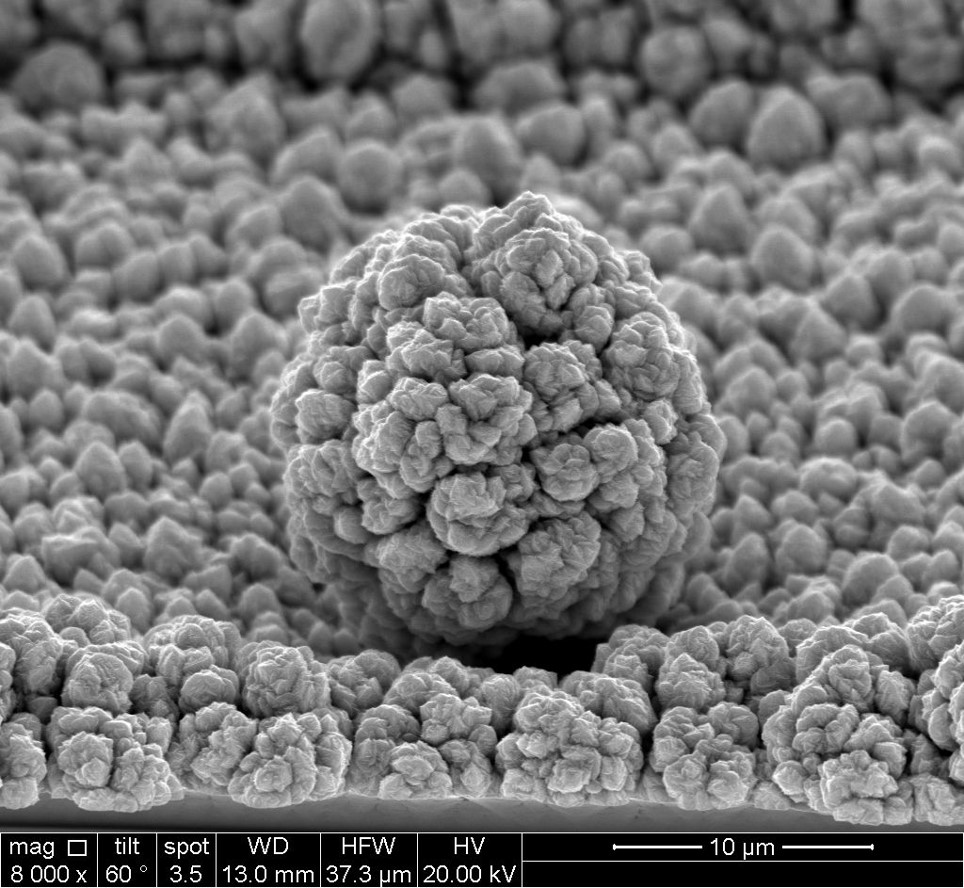
Even when the macroscopic field $\mathbf{B}$ is aligned parallel to the mean current $\mathbf{J}$ (so $\mathbf{J}_{\text{mean}} \times \mathbf{B} = 0$), strong local convection still appears! Any surface protrusion, dendrite tip, or insulating $\text{H}_2/\text{O}_2$ gas bubble bends nearby ionic current lines radially around itself, producing non-zero local $\mathbf{J}_{\text{loc}} \times \mathbf{B}$ micro-MHD vortices.
In alkaline and PEM water electrolyzers, micro-MHD swirling around nucleating bubbles reduces their critical detachment diameter, sweeps away bubble curtains that otherwise block active catalyst area, and lowers cell overpotential—improving green-hydrogen energy efficiency.
3. Magnetic Gradient Force ($\mathbf{F}_{\nabla B}$) for Structured Deposition
When paramagnetic ions ($\text{Cu}^{2+}$, $\text{Co}^{2+}$, $\text{Ni}^{2+}$, $\text{Fe}^{2+}$) are deposited in a spatially non-uniform magnetic field—such as above patterned magnetized micro-wires—an additional Kelvin paramagnetic gradient force acts on concentration gradients (Mutschke et al., 2013):
$$\mathbf{F}_{\nabla B} = \frac{\chi_{\text{mol}} c}{\mu_0} (\mathbf{B} \cdot \nabla)\mathbf{B}$$Unlike the Lorentz force, $\mathbf{F}_{\nabla B}$ acts directly on paramagnetic ions even at zero current, trapping or depleting metal ions near high-gradient magnetic poles to template inverse or conformal 3D metallic microstructures without lithography.
Key Milestones & Literature Review
- Permanent-Magnet MHD Convection (2001): N. Leventis and X. Gao (2001) demonstrated that compact NdFeB permanent magnets induce vigorous boundary-layer convection in aqueous cells, quantitatively verifying the $B^{1/3}$ scaling of diffusion-limited current.
- Lorentz vs. Kelvin Gradient Forces (2009–2013): Kristina Tschulik, J. A. Koza, M. Uhlemann, A. Gebert, and L. Schultz (2009) and Gerd Mutschke et al. (2013) combined micro-electrodeposition experiments with 3D coupled Navier–Stokes–Nernst–Planck simulations to separate macro-MHD Lorentz convection from Kelvin paramagnetic gradient forces ($\mathbf{F}_{\nabla B}$) in structured copper and bismuth coatings.
- Macro/Micro-MHD Synthesis (2014): L. M. A. Monzon and J. M. D. Coey (2014) unified macro-MHD boundary-layer thinning, micro-MHD bubble detachment in water electrolyzers, and chiral electrodeposit morphology under Lorentz forces.
References
- Monzon, L. M. A., & Coey, J. M. D. (2014). Magnetic fields in electrochemistry: The Lorentz force. A mini-review. Electrochemistry Communications, 42, 38–41. https://doi.org/10.1016/j.elecom.2014.02.006
- Mutschke, G., Tschulik, K., Weier, T., Uhlemann, M., Bund, A., & Fröhlich, J. (2013). On the action of magnetic gradient forces in micro-structured copper deposition. Electrochimica Acta, 108, 709–717. https://doi.org/10.1016/j.electacta.2012.12.060
- Tschulik, K., Koza, J. A., Uhlemann, M., Gebert, A., & Schultz, L. (2009). Effects of well-defined magnetic field gradients on the electrodeposition of copper and bismuth. Electrochemistry Communications, 11(11), 2241–2244. https://doi.org/10.1016/j.electacta.2009.04.010
- Leventis, N., & Gao, X. (2001). Nd-Fe-B permanent magnet-induced magnetohydrodynamic convection in electrochemistry. Analytical Chemistry, 73(16), 3981–3992.