
MHD Power Generation
Converting high-temperature plasma or liquid-metal kinetic energy directly into electricity without turbines—covering Faraday, Hall, and diagonal channels, open- vs. closed-cycle systems, and enthalpy extraction.
Generating Electricity Without a Spinning Turbine
Every conventional coal, gas, or nuclear power plant converts heat into electricity in two clumsy mechanical steps: first, hot steam or gas spins a multi-stage turbine; second, the turbine spins a copper-wound generator. Magnetohydrodynamic (MHD) power generation eliminates the moving turbine entirely. Instead of spinning copper wires through a magnetic field, a super-hot, electrically conducting gas (plasma) or liquid metal is blasted at high speed through a stationary magnetic duct—turning Faraday’s law of induction directly on the fluid itself.
Because an MHD channel has no rotating blades exposed to the hottest gas stream, it can operate at inlet temperatures of $2500\text{--}3000\;\text{K}$—far above the $\sim 1700\;\text{K}$ metallurgical limit of nickel-superalloy gas turbines. By Carnot’s theorem, higher peak temperature unlocks higher thermal efficiency: combined-cycle MHD–steam plants were engineered to reach $50\text{--}60\%$ overall efficiency by using the MHD duct as a “topping cycle” and feeding its $2000\;\text{K}$ exhaust into a conventional steam bottoming plant.
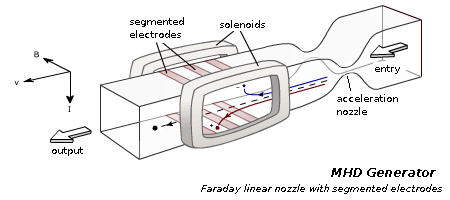
Open-Cycle Plasmas vs. Closed-Cycle Noble Gases and Liquid Metals
MHD generators fall into three physical regimes depending on the working fluid:
- Open-Cycle Combustion MHD: Fossil fuel (coal or natural gas) is burned with preheated, oxygen-enriched air at $2700\text{--}3000\;\text{K}$ and seeded with $1\%$ potassium carbonate ($\text{K}_2\text{CO}_3$) or cesium. Because potassium has a low ionization potential ($4.34\;\text{eV}$), thermal ionization yields $\sigma \approx 10\text{--}30\;\text{S/m}$. Landmark facilities such as the Soviet U-25 ($20\;\text{MW}_\text{e}$ MHD output) and the US DOE CDIF/CFFF programs proved multi-megawatt operation, though slag corrosion of electrodes and seed recovery remained major hurdles.
- Closed-Cycle Inert-Gas MHD: Helium or argon seeded with $\sim 0.1\%$ cesium operates at lower gas temperatures ($1800\text{--}2100\;\text{K}$) by exploiting non-equilibrium ionization ($T_e > T_{\text{gas}}$ via Joule heating of electrons).
- Liquid-Metal MHD (LMMHD): A two-phase mixture of liquid sodium, NaK, or lead–bismuth and a driving gas/vapor passes through the duct. With $\sigma \sim 10^6\;\text{S/m}$ at modest temperatures ($400\text{--}1000\;\text{K}$), LMMHD avoids plasma chemistry and pairs naturally with solar thermal or fast nuclear heat sources.
Professional Deep Dive: Generalized Ohm’s Law, Hall Effect & Channel Topologies
In a weakly ionized combustion or noble-gas plasma, electrons are vastly more mobile than heavy ions. Under a strong magnetic field $\mathbf{B} = B\hat{\mathbf{z}}$, electrons gyrate at cyclotron frequency $\omega_{ce} = eB/m_e$ between collisions (collision frequency $\nu_e$). The ratio is the electron Hall parameter:
$$\beta_e = \frac{\omega_{ce}}{\nu_e} = \mu_e B$$where $\mu_e$ is electron mobility. The generalized Ohm’s law (neglecting ion slip) reads:
$$\mathbf{J} = \sigma (\mathbf{E} + \mathbf{u} \times \mathbf{B}) - \frac{\beta_e}{B} (\mathbf{J} \times \mathbf{B})$$For channel flow $\mathbf{u} = u\hat{\mathbf{x}}$ and $\mathbf{B} = B\hat{\mathbf{z}}$ with $E_z = J_z = 0$, the component equations are:
$$J_x = \frac{\sigma}{1 + \beta_e^2} \Big[ E_x - \beta_e (E_y - uB) \Big], \qquad J_y = \frac{\sigma}{1 + \beta_e^2} \Big[ (E_y - uB) + \beta_e E_x \Big]$$Why Continuous Electrodes Fail: Segmented Faraday vs. Hall vs. Diagonal
If a generator uses continuous top and bottom electrodes, they short out the axial Hall field ($E_x = 0$). Then $J_y = -\frac{\sigma}{1+\beta_e^2}(uB - E_y)$, meaning the effective conductivity drops by a factor $(1 + \beta_e^2)$—a catastrophic penalty when $\beta_e \sim 2\text{--}5$.
To recover performance, engineers choose one of three classic designs (Rosa, 1987):
- Segmented Faraday Generator: Opposite electrode pairs are electrically insulated axially ($J_x = 0$). Setting $J_x = 0$ yields $E_x = \beta_e (E_y - uB)$, which cancels the $\beta_e^2$ penalty: $$J_y = -\sigma u B (1 - K_F), \qquad K_F = \frac{E_y}{uB} \in (0, 1)$$ The power density extracted is $P_V = -\mathbf{J}\cdot\mathbf{E} = \sigma u^2 B^2 K_F (1 - K_F)$, peaking at $K_F = 0.5$ with local electrical efficiency $\eta_{\text{el}} = K_F$.
- Hall Generator: Opposite electrodes are shorted ($E_y = 0$), and the load is connected between upstream and downstream ends. Defining $K_H = -E_x / (\beta_e u B)$, power density scales as $\frac{\beta_e^2}{1+\beta_e^2} \sigma u^2 B^2 K_H (1 - K_H)$, which becomes competitive only at high Hall parameter ($\beta_e \gtrsim 3$).
- Diagonal Conducting Wall (DCW) Channel: Pairs of electrodes are linked along equipotential lines tilted at angle $\theta$ ($\cot \theta = E_x / E_y$), combining a single external load circuit with high efficiency across moderate $\beta_e$.
Enthalpy Extraction and Magneto-Acoustic Stability
In a compressible duct, the Lorentz force $\mathbf{J} \times \mathbf{B}$ decelerates the flow ($J_y B < 0$) while extracting electrical enthalpy. The enthalpy extraction ratio scales with the magnetic interaction parameter $N = \sigma B^2 L / (\rho u)$ and Mach number $M$. Crucially, in non-equilibrium noble-gas channels where $\sigma \propto \exp(-E_{\text{ion}} / 2 k_B T_e)$, fluctuations in Joule heating can trigger electrothermal (ionization) instabilities when $\beta_e > \beta_{\text{crit}} \approx 1.5\text{–}2$, creating plasma striations that degrade effective conductivity.
Key Milestones & Literature Review
- Channel Theory & Engineering Foundations (1961–1987): Richard J. Rosa (1987) systematized the generalized Ohm’s-law analysis of segmented Faraday, Hall, and diagonal conducting-wall (DCW) channels, quantifying end-loss shorting, boundary-layer voltage drops, and seeded combustion-plasma conductivity.
- Multi-Megawatt Pilot Plants (1970s–1980s): Soviet (U-25, achieving $20\text{ MW}_\text{e}$ MHD output) and US DOE (CDIF / CFFF) teams demonstrated sustained megawatt-scale open-cycle operation, proving rapid start-up and slagging-wall survivability while exposing electrode erosion and seed-recovery challenges.
- Combined-Cycle & Environmental Analysis (1993–2017): M. Ishikawa and J. Umoto (1993) modeled coal-fired and closed-cycle MHD–steam combined plants achieving $>50\%$ thermal efficiency with reduced $\text{NO}_x$/$\text{SO}_x$ emissions, and P. A. Davidson (2017) unified channel-efficiency and Hall-parameter limits.
References
- Rosa, R. J. (1987). Magnetohydrodynamic Energy Conversion (Revised ed.). Hemisphere Publishing. https://doi.org/10.1007/978-94-015-7883-7
- Davidson, P. A. (2017). Introduction to Magnetohydrodynamics (2nd ed.). Cambridge University Press. https://doi.org/10.1017/9781316672853
- Ishikawa, M., & Umoto, J. (1993). Environment-friendly MHD power generation. Energy Conversion and Management, 34(8), 597–605. https://doi.org/10.1016/0196-8904(93)90097-T