MHD Propulsion and the Yamato-1
How magnetohydrodynamic thrusters accelerate seawater with no moving parts—from the physics of the Lorentz force to Japan's Yamato-1 sea trials and modern superconducting concepts.
Pushing a Ship Without a Propeller
Imagine a submarine or surface vessel gliding through the ocean without a spinning propeller, a drive shaft, or a gearbox—powered only by silent electric currents and magnetic fields acting directly on the water. That is the promise of magnetohydrodynamic (MHD) propulsion, made famous in popular culture by Tom Clancy’s The Hunt for Red October and demonstrated in the real world by Japan’s experimental vessel Yamato-1 in 1992.
Seawater is not an electrical insulator; dissolved sodium and chloride ions ($\text{Na}^+$, $\text{Cl}^-$) give ocean water an electrical conductivity of roughly $\sigma \approx 4\text{--}5\;\text{S/m}$. Whenever an electric current passes through a conductor inside a magnetic field, nature produces a sideways push known as the Lorentz force. In a conventional electric motor, that push spins a copper rotor connected to a propeller. In an MHD thruster, seawater itself is the moving conductor: water enters an open duct beneath the hull, crosses a strong magnetic field while an electric current flows between two electrodes, and is accelerated out the stern as a silent water jet.
Because there are no rotating blades, cavitation noise and mechanical vibration are dramatically reduced—explaining decades of naval interest in ultra-quiet propulsion. Yet the same physics reveals why MHD ships have not replaced propellers: seawater’s conductivity is nearly ten million times lower than that of copper or liquid sodium. Pushing meaningful thrust through such a weakly conducting fluid demands immense magnetic fields ($4\text{--}10\;\text{T}$) from cryogenic superconducting magnets, and even then, most of the electrical input is lost as Joule heating and electrolysis bubbles at the electrodes.
Yamato-1: From Theory to Sea Trials
After early conceptual studies for cargo submarines by Way (1968), the Ship & Ocean Foundation in Japan launched a landmark USD 55 million program to build a full-scale MHD-propelled catamaran, Yamato-1 (Motora et al., 1991).
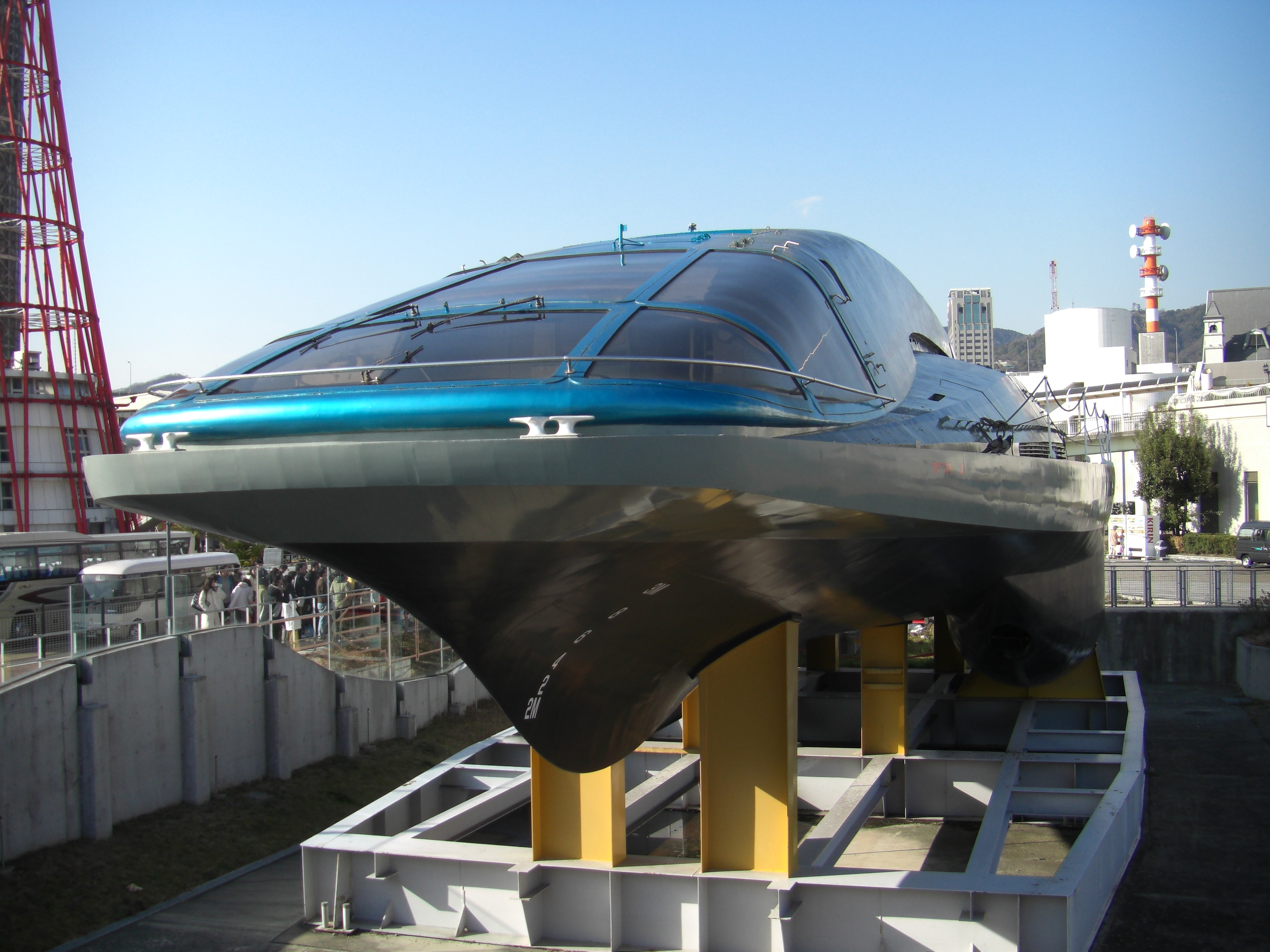
Key engineering parameters of Yamato-1 during its June 1992 trials in Kobe Harbour included:
| Parameter | Value | Physical / Engineering Significance |
|---|---|---|
| Hull length / displacement | $30\;\text{m}$ / $185\;\text{t}$ | Twin-hull aluminium catamaran minimizing drag |
| Thrusters | Two 6-duct dipole units | Each duct $240\;\text{mm}$ diameter, arranged in a ring to contain stray flux |
| Superconducting magnets | NbTi coils at $4.2\;\text{K}$ | Peak bore field $B \approx 4\;\text{T}$ (design), $2.2\text{--}3.5\;\text{T}$ in sea trials |
| Electrode current | $\sim 2000\;\text{A}$ per duct | Supplied by onboard diesel generators |
| Total thrust / top speed | $\sim 8\;\text{kN}$ / $6.6\;\text{knots}$ ($12\;\text{km/h}$) | Overall propulsion efficiency $\eta_{\text{tot}} \approx 1\text{--}2\%$ |
Professional Deep Dive: Governing Equations & Efficiency Limits
1. Channel Momentum & Ohm’s Law
Consider a uniform rectangular MHD thruster duct of cross-sectional area $A = w \cdot h$ and active magnetic length $L$, with seawater flowing at mean axial velocity $u$ along $\hat{\mathbf{x}}$, an applied transverse magnetic field $\mathbf{B} = B\hat{\mathbf{z}}$, and an applied voltage $V$ across electrodes separated by width $w$ along $\hat{\mathbf{y}}$.
By Ohm’s law for a moving conductor, the transverse current density $J_y$ (neglecting Hall effects, since the electron/ion Hall parameter in seawater is $\beta_H \ll 1$) is:
$$J_y = \sigma (E_y - u B) = \sigma \left(\frac{V}{w} - u B\right)$$Here $E_y = V/w$ is the applied electric field and $uB$ is the back-electromotive force (back-EMF) induced by the moving seawater. Defining the load factor $K = \frac{V}{u B w} > 1$ (thruster mode; $K < 1$ corresponds to an MHD generator), the current density becomes:
$$J_y = \sigma u B (K - 1)$$The total Lorentz thrust generated over the active duct volume $\mathcal{V} = w h L$ is:
$$T_{\text{MHD}} = \int_{\mathcal{V}} (\mathbf{J} \times \mathbf{B})_x \, dV = J_y B w h L = \sigma u B^2 (K - 1) w h L$$The hydrodynamic pressure rise across the thruster is therefore $\Delta p_{\text{MHD}} = \sigma u B^2 (K - 1) L$, which must overcome viscous wall friction and hull drag.
2. Electrical Efficiency & Why Conductivity Dominates
The mechanical power delivered to the fluid is $P_{\text{mech}} = T_{\text{MHD}} u$, while the total electrical power drawn from the power supply (excluding magnet cryogenics and electrode overpotentials $\Delta V_{\text{elec}}$) is $P_{\text{elec}} = V J_y h L = K u B w J_y h L$. Their ratio gives the ideal electrical efficiency $\eta_{\text{el}}$:
$$\eta_{\text{el}} = \frac{P_{\text{mech}}}{P_{\text{elec}}} = \frac{1}{K} = \frac{1}{1 + \dfrac{J_y}{\sigma u B}}$$Alternatively, writing efficiency in terms of the interaction parameter (Stuart number) $N = \frac{\sigma B^2 L}{\rho u}$ and the thrust coefficient reveals the fundamental bottleneck of seawater MHD:
- At $B = 4\;\text{T}$, $\sigma = 4.5\;\text{S/m}$, $L = 3\;\text{m}$, and $u = 10\;\text{m/s}$, the magnetic interaction parameter is only $N \approx 0.02$.
- Because $N \ll 1$, achieving appreciable thrust requires $K \gg 1$ (e.g. $K \sim 10\text{--}50$), which drives $\eta_{\text{el}} = 1/K$ down to $2\text{--}10\%$, with $90\text{--}98\%$ of electrical energy dissipated as ohmic heating $J_y^2/\sigma$ in the brine.
- Furthermore, seawater electrolysis at the electrodes ($\text{2Cl}^- \to \text{Cl}_2 + 2e^-$ at the anode, $2\text{H}_2\text{O} + 2e^- \to \text{H}_2 + 2\text{OH}^-$ at the cathode) introduces a fixed $2\text{--}3\;\text{V}$ overpotential loss and generates gas bubbles that lower effective conductivity $\sigma_{\text{eff}}$ and compromise acoustic stealth.
3. Modern Research Directions
Recent reviews (Kosasih & Takeda, 2026) highlight three active frontiers aimed at overcoming the low-$N$ barrier:
- High-Temperature Superconducting (HTS) Magnets ($\text{REBCO}$ / $\text{MgB}_2$): Operating at $20\text{--}50\;\text{K}$ rather than $4.2\;\text{K}$ slashes cryogenic mass and enables compact $10\text{--}15\;\text{T}$ saddle or helical coils, scaling $\eta_{\text{el}}$ upward via $B^2$.
- Helical & Induction Seawater Thrusters: Eliminating direct-contact electrodes removes chlorine evolution, though AC induction requires high frequencies and suffers from skin-depth mismatch in low-$\sigma$ seawater.
- Liquid-Metal / Magneto-Plasma Hybrid Thrusters: Using a closed liquid-metal primary MHD loop (where $\sigma \sim 10^6\text{ S/m}$, $\eta_{\text{el}} > 70\%$) coupled to a mechanical jet, or seeding plasma in supersonic aerospace inlets.
Key Milestones & Literature Review
- Early Submarine Concepts & EMS-1 (1960s): Stewart Way (1968) formulated the engineering theory of external- and internal-duct superconducting seawater thrusters for cargo submarines and led the EMS-1 scale-model test, proving silent thrust generation while identifying low seawater conductivity as the central efficiency bottleneck.
- Full-Scale Yamato-1 Sea Trials (1991–1992): Seizo Motora, Kensaku Imaichi, Masayoshi Nakato, and Seiki Takezawa (1991) engineered Japan’s 185-tonne Yamato-1 test vessel with twin 6-duct NbTi superconducting thrusters, achieving 6.6 knots in Kobe Harbour and validating multi-duct flux containment and electrode durability at sea.
- Theoretical Synthesis & HTS Revival (2017–2026): Peter Davidson (2017) established the canonical channel-efficiency and load-factor scaling ($\eta_{\text{el}} = 1/K$), while B. Kosasih and M. Takeda (2026) recently reviewed how high-temperature superconducting (HTS) magnets ($\text{REBCO}$, $\text{MgB}_2$), helical geometries, and electrolysis-bubble mitigation can raise marine MHD thruster performance.
References
- Way, S. (1968). Electromagnetic Propulsion for Cargo Submarines. Journal of Hydronautics, 2(2), 49–57. https://doi.org/10.2514/3.62773
- Motora, S., Imaichi, K., Nakato, M., & Takezawa, S. (1991). An outline of the R&D project on superconducting MHD ship propulsion in Japan. In OCEANS '91 Proceedings (pp. 53–68). IEEE. https://doi.org/10.1109/OCEANS.1991.606542
- Kosasih, B., & Takeda, M. (2026). Magnetohydrodynamic Marine Propulsion: A Comprehensive Review of Seawater Thrusters, Superconducting Magnets, and Hydrodynamic Efficiency. Magnetochemistry, 12(8), 89. https://doi.org/10.3390/magnetochemistry12080089
- Davidson, P. A. (2017). Introduction to Magnetohydrodynamics (2nd ed.). Cambridge University Press. https://doi.org/10.1017/9781316672853